What do you see?
Updated: Oct 16, 2025
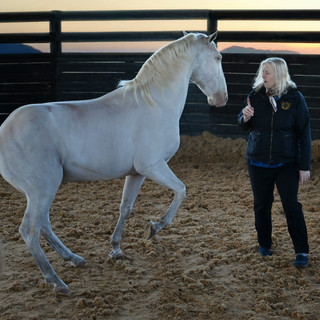
This photo of the Lusitano, Roucio, is one of the most famous images created by our founder and equine photographer, Susan McClafferty of Mareish Media. Observers often remark that he looks vicious, or angry, or unhappy in this image. It provides us with a wonderful opportunity to explore horse facial and postural cues to see how he is actually feeling. The final image has been rotated somewhat for artistic dramatic effect, so we gave 6 of the unedited behind-the-scenes photos (shown below), including the original of this one to a deep learning model of AI and asked it to use the EquiFACS facial coding system for horses to provide an assessment. What follows is that detailed assessment.

🧠 Contextual Overview
The horse is being photographed under studio lighting using vivid opposing color gels (magenta and cyan). This lighting setup can subtly influence a horse’s posture and expression: artificial lighting, the enclosed space, and handler proximity all factor into body language interpretation. Since the lighting conditions here are not natural, behavioral cues must be evaluated with a focus on muscle tension, eye orientation, nostril shape, and ear carriage—not color tone or light intensity.
🐴 EquiFACS-Based Expression Analysis
Ears
Action Units: EA1 (ears forward), EA2 (ears outward), EA3 (ears back).
Across images, the ears are mostly neutral to partially back, occasionally tilted laterally rather than pinned.→ This typically indicates focus and mild uncertainty, not aggression or fear. It’s a “listening back” position—common when horses attend to a handler behind or beside them.
Interpretation: The horse is attentive to the handler and responsive to subtle cues, possibly processing mixed sensory input (lighting, handler, camera noise).
Eyes
Action Units: AU101 (eye widening), AU143 (eye closure).
The horse’s eyes are soft to moderately narrowed, with no visible sclera (“whites”).→ Indicates calm attention, not alarm. No orbital tension, no upper lid lift, and no dilated pupils are detectable in this light.
Interpretation: The horse shows composure and low arousal, suggestive of trust or mild submission in response to handler cues.
Nostrils
Action Units: AD38 (nostril dilator), AD81 (nostril lift).
Nostrils are relaxed and rounded, with no flare or wrinkling at the commissure.→ Suggests neutral respiration and absence of stress-related tension. Flared nostrils would signal readiness to move or mild anxiety; that’s not seen here.
Interpretation: Breathing appears steady and relaxed — the horse is not under visible stress.
Muzzle / Lips
Action Units: AU24 (upper lip raiser), AU25 (lips part), AU26 (jaw drop).
The lips remain closed, the lower lip is not drooping, and there’s no chin tension.→ This shows relaxed affect, not submission, frustration, or agitation. Mild skin tension around the muzzle in some frames reflects momentary cue-following (e.g., flexion request or shift in balance).
Interpretation: Muzzle tone suggests acceptance and mild concentration — a “working” mindset.
Head & Neck Posture
The neck is arched and flexed in multiple frames, with poll flexion at or below the vertical.
In EquiFACS this combines AD105 (neck extension/flexion) with posture cues.
When voluntary and relaxed, this can be a gesture of softness or connection.
When forced or accompanied by mouth tension, it can indicate submission or conflict.
Interpretation: Because the facial relaxation and eye softness are consistent, the flexion here likely reflects cooperative engagement, not coercion. The head lowering is a calming signal—horses often lower the head slightly when relaxed or seeking connection.
Mane & Hair Motion
Hair motion upward and forward in several frames indicates micro-movement, not startle. This occurs naturally when the horse shifts weight or subtly shakes the crest, often during handler cues. No retraction or jerked movement visible → not fear or irritation.
⚖️ Behavioral Context
Handler Interaction:
The handler’s proximity and rope contact appear calm, with loose slack and a non-confrontational posture. The horse’s line of focus remains toward the handler — not evasive, not defensive. No wide eyes, nostril flaring, or pinned ears confirm mutual trust and habituation to this setup.
Environmental Tolerance:
Horses can perceive bright colored light differently; saturated pinks and blues fall near the edge of equine visual sensitivity. Studies (Hanggi, 2007; Smith & Goldman, 2019) show horses perceive blues more strongly than reds, meaning this lighting is likely visually calming rather than startling.
🧩 Emotional State Synthesis
Category | Indicators | Interpretation |
Arousal | Low eye tension, relaxed nostrils, mild ear motion | Low to moderate arousal (engaged, not anxious) |
Valence | Soft eye, lowered head, relaxed muzzle | Positive to neutral emotional state |
Engagement | Directed attention to the handler | High attentional engagement |
Trust/Comfort | No avoidance, relaxed stance | Evidence of handler trust |
🧬 Summary: Likely Emotional State
“Focused relaxation with cooperative intent.”
This horse shows consistent indicators of comfort, attentiveness, and willingness to engage with its handler under unusual studio conditions. There is no sign of tension, avoidance, or fear. The flexed posture is likely a response to a trained cue or calm engagement rather than conflict or submission.
The overall affect aligns with EquiFACS patterns associated with affiliative interaction, not stress.
Comments